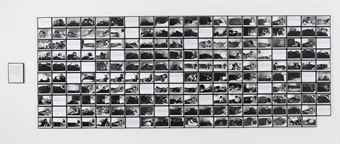
As an intriguing, almost eccentric character whose choice of subject matter and exhibitionism of privacy consistently incites controversy, the study of Sophie Calle and her work is one of unique yet almost simplistic style of documentation where the contents of other people’s lives are the uncompromising muse.
Sophie Calle
Side Effects by Woody Allen
Upon wandering around a car boot sale during my latest visit to the UK, which would have been completely guileless had it not been for the sheer novelty of going to a car boot sale, I came across a box of 70s paperbacks whose pricing proved that the owner was desperate to be relieved of them. The bright pink letters of Allen's name showed themselves upon further sifting, and I'm pretty sure that it was out of sheer shock (I was pretty convinced that Woody Allen's work was purely in film and theatre) that I made the purchase.
For a while the paperback lay untouched in the vast pile of summer reads that failed to be completed as punctually as the label implies, and it was one of the myriad of books that I hauled back to Singapore. I didn't so much as open the pages until the following December, when the blurb's content proved to be of the utmost relevance to my state of mind (note that I did said state of mind, not being. Naturally my youthful -female- hairline is not receding). For the week-or-so leading up to the Christmas holiday these snippets of fiction made for great bedtime companions at the end of a stressful day, as it turns out that the book comprises 17 short stories, most -if not all- of which have been previously published in either The Kenyon Review, New Republic or The New Yorker.
As my father once aptly put it, I see Woody Allen as a bit of a kindred spirit. I absolutely love the scope of his (undeniably idiosyncratic) humour; pretentious, neurotic, self-aware, and intellectual to the point where you want to laugh out loud at his jokes for the sole purpose of making it apparent to others just how knowledgable you are. I knew nothing about Side Effects, but I had a great deal of faith in the guarantee of its hilarity, and I was genuinely curious as to how Allen's humour would translate to prose.
"Favourably" would be the answer to appease this curiosity. There is an inherent difference between Woody Allen's story-writing and Woody Allen's screenwriting, but it proves essential to ensure success as a short story. It was apparent in some short stories that Allen had channeled slightly more surreal aspects that his movies do not allow for. On a number of occasions both his style of writing and sense of humour reminded me very much of Douglas Adams, which was an extremely pleasant yet shocking find.
In summary, I have nothing but good things to say about this consolidation of Woody Allen's short stories. Whether you're a fan of his work or not, they're diverse and consistent in their undeniable hilarity. Like it claims to, these fragments of prose make for an excellent bedside companion for whenever you reach a stage of involuntary consciousness in the small hours.
Current Reads
1. Lolita by Vladimir Nabokov
The latest addition to my bookshelf, this consolidation of florid prose and provocative subject matter has eluded me for some time. I'm roughly 80 pages into the 360-page novel right now, and though I find the pretentious narrative voice off-putting at times, I have to respect Nabokov for his prowess as a wordsmith, and the (near-)ephemeral bouts of portrayal of the novel's content that are absolute perfection, for want of a slightly more realistic word.
2. Jane Eyre by Charlotte Brontë
My first exposure to the story of Jane Eyre was watching the 2011 film adaptation while it was still out in cinemas. Though I remember little of it, at the time I respected it for how it was artistically shot in a way that made it differ greatly from many other costume dramas. Like a surprising number of reads, I started this book after acquainting myself with the contents of a friend's bookshelf mid-sleepover.
I've reached the nineteenth chapter of this Victorian classic, so almost halfway through. Like most writers of her calibre I revel in Brontë's style of writing, and though I put little importance on the plot of most the stories I read, I find that of Jane Eyre beguiling enough to keep me reading with interest in what transpires. The first ten chapters (which the narrator herself points out to have documented the first ten years of her life) contain extremely brief parts where the protagonist's portrayed response to her experiences lamentably remind me of a more recent literary trend - the "tragic life" novel, something I have spent a lot of time justifying my abject distaste for. Of course the mirthless comedy of this point is that the two genres of writing are a couple of centuries apart, so I suppose I could blame the fundamental fault I find with this novel on my modern cynicism and attempt at being discerning.
3. Catch-22 by Joseph Heller
The finishing of this satirical classic has been a work in progress for a staggering two years, but I have thoroughly enjoyed what I've read (about 300 pages) nonetheless, and the novel was once again dug out of my book collection to satiate a week-long stint of ennui. Catch-22 is packed with the humour of absurdity and paradox, whilst retaining a bearable degree of realism through the backdrop of a World War II American bombardier camp in the Mediterranean. The beauty of this novel's content is that the context merely serves as the backdrop for its themes, which highlight the farce of bureaucracy and the nature of paradox, the most prominent of which being the relationship between insanity and self-awareness. This is a staple read for anyone with a love for clever farce, satire and dark comedy.
4. The Great Gatsby by F. Scott Fitzgerald
With the imminent threat of the GCSE English literature exam getting the better of me, I find myself immersed in Nick Carraway's summer of '22 for the fourth time, though I firmly believe that such repetitive reading will not exhaust my profound reverence for Scott Fitzgerald, who I shall prematurely crown my favourite author. With exceptional prose he depicts the conflict of modern ideals and romanticism, and with unfounded wistfulness captures the energy of a nation bound for failure and regress. Since this will be the first time reading it in this particular edition, I have the surprising intellect of a lengthy introduction to (hopefully) help me see the novel through an intelligent eyes. My other set work for English is Oscar Wilde's most famous play, The Importance of Being Earnest.
The seven constraints derived from calling yourself a writer
1. Everybody writes. Everybody. The teenage
girl whose Tumblr squashes sporadic paragraphs between reblogged photos, and
the forty-year-old man whose job becomes unspeakably insignificant as his 400-page
manuscript awaits much groveling at Random House are barely distinguishable in
the judgements made on them by society. The toughest, most soul-crushing stage
of being a writer is probably the effort put into not being defined by either
stereotypes. (As a matter of perfect coincidence, both have made adequately
prolific comments on society.)
2. The word “submission”
induces a frustrating bout of writers’ block potentially
lasting for years. “We want writing that’s quirky,” “ we look for short stories
full of gut-wrenching soul,” “our subject matter embodies the glacial attitudes
of the bourgeoisie”; every submission guideline ever read - even “we require
experience and a $3 postage fee” compels you to mentally scream “YES, that’s
me! I can write for that!” On average it takes less than a minute to realise
that you were lying. You have your imagined prominence as contributor for the
publication in question all figured out, in one swift move accelerating past
the ideas for subject matter, articulation of thoughts and stylistic refinement
that should technically come first. But hey, who needs the bureaucratic
‘creative process’ when you have ambition?
3. Blogs that are
non-literary render you groggy. It could be down to
the dissent of - yet ultimately successful
- command of syntax, or the “professional” look of their page, or the blatant
milestones in the field of readership and pageviews, but something about a
fashion blog run by a high-school student who is languidly torn between an
internship at Elle or Vogue leaves you in a stuporous revelation that her
present is far brighter than your future. You blame the ease of fame that comes
with blogging under such a popular genre, but secretly you’re just a little bit
upset because clearly nobody has an interest in your acclaim for J.D. Salinger
post-Catcher in the Rye. The moment
quickly preludes the impulse to become a fashion blogger yourself - an idea soon put to bed by the realisation
that most garments have to be identified as plural on your watch.
4. People actually forget
that you want to be perceived as a writer. Unless
you were born with just initials instead of a first and middle name, your
chosen identity as a wordsmith will nearly always omitted in conversation,
particularly when your self-esteem depends on it. Singers, guitarists and
dancers get a standing ovation, artists have their exhibitions, or at least the
prospective abundance of ‘likes’ should work make its way to the internet, and
then there are the unpublished writers, who are lucky if their names and
ill-thought-out poetry are printed in the school writing magazine (the audience
of which is solely made up of its editors) and have zealous thoughts on the
symbolic significance of Gatsby’s swimming pool treated with an air of “save it
for the English books, honey.” If you’re really
lucky, the attitudes of others can transition from condescension to awkward,
half-hearted acknowledgement.
5. You strive to be a
conversational thesaurus. It is down to the feeling
that you lack profundity and story-telling skills that are responsible for
spawning the idea that it will be easier to become F. Scott Fitzgerald than
Ernest Hemmingway (just for a second allow yourself to imagine that the
former’s books lack substance). It becomes a genuine fear of yours that the
phrase “a good vocabulary doesn’t necessarily mean good writing” might actually
catch on as a cornerstone for criticism.
6. Thanks to you, Moleskine
will never go out of business. There’s something
about the (frankly too thin) sallow pages with unicolour minimalism for a cover
that commands the desire of nearly every writer, and has somehow reserved a
perfect rectangular spot in every weathered satchel from day one. It suddenly
becomes not a question of what brand of notebook but instead the choice of hard
or soft cover that serves as a key point in defining your personality. The
elastic band that firmly snaps the 100-or-so pages shut allows your Moleskine
to serve as a quaint yet unsightly breeding ground for crumpled excerpts of
spontaneity and stained pieces of parchment-thick paper. And you’re truly naïve
if you think it stops at the purchase of one Moleskine; soon enough you’ll have
a small soft-covered one for epigrams, a large hard-covered ones for critical
works, and that fiery red one will be reserved for impassioned sonnets, ballads
and sensationalist novellas that fail to ever materialise.
7. Chances are, you already
have a complex about your level of ability. Rejection
is a state of being that every writer is expected to be a calm acquaintance of,
when in reality it can crush all emotional stability with immediate, sustained
effect. You firmly uphold the belief that you epitomise all human inarticulacy,
while simultaneously sending every piece of work to a friend over Skype.
Fortunately your chosen means of communication allow for a limitless stream of
self-deprecation to ensue. Repertoire of statements range from “it’s really
nothing special,” to “oh my gosh I can feel myself physically cringing upon
re-reading this,” to the heightened implausibility of “oops sorry I really
didn’t mean to send that.” Punctuation is not necessary in any of these as an
instinctive interjection of “haha” after certain words work with equal, if not
greater efficacy. It appears that most writers challenged by their precarious
level of success and praise from others steep themselves in this dramatised
paradox of maintaining this intellectual frustration whilst somehow using the
word “intellectual” to describe their own experiences. On the bright side, such
quasi-depression is writing gold.
F. Scott Fitzgerald once said that “If they’re any good, [writers are] a whole lot of people
trying so hard to be one person.” Now, my own proficiency in the world of
literature renders me an all but credible interpreter of what the voice of an
age has to say, but I’m pretty sure this statement is applicable beyond our
attempts at characterisation. We are the introverts that crave attention, the
mavericks that knowingly buy into a uniform brand of notebook, and the (albeit
slight) neurotics who scrape by in balancing diffidence with abject egotism.
Ultimately, we know that our pen name has to amount to one definite
person. That is, if we want its appearance to make it past the manuscript
stage.
The pictures have turned pink by now
Embedded in my memory is the inexhaustible balminess of France’s
aestival sun that each year thawed the rosy layers of snow and dew-droplets
that frosted my cheeks from an English winter. Blissful days from an era that
seemed endless flow through me, forever unperturbed in their state of untainted
nostalgia.
It’s five o’ clock, and sunlight adorns the cobbled, whitewashed
walls with a geometric arabesque of wrought-iron shadows and strokes of orange
incandescence. The wholesome promise of a soon-to be dinner fills my nose with
every inhaled sigh, glorious solar flares, softened by the darkening sky,
stream across sea-washed eyes at every turn, and sand caught between my toes
serve as the raconteurs of a day’s trip to the beach. The distant sound of
chattering grown-ups waft across the garden, whilst my sister, childhood friend
and I sit cross-legged in the grass, fervently linking daisy chains and voiding
occasional chatter with our own silent musings. As dinner takes care of itself
we hear the dull thuds of our fathers playing a clumsy game of cricket. We rise
up with surprising animation after the two gospelised syllables - “dinner!” -
are heard, as we sit ourselves down on chairs of weathered, off-white plastic.
Conversation goes on long into the evening, and the summer heat
propels the calm yet animated atmosphere to a point of elusive listlessness,
amongst child and adult alike. Behind us, darkwood shutters remain open to
inescapable balmy heat, taking in with ravenous draws of breath what little
breeze it can. Behind these open windows and betwixt these creaking floorboards
live niches and interstices, lying in the redolence of moschate abandonment.
Unbeknownst to us, they await the brushing away of cobwebs and rekindling of
human touch that takes the form of slight palms and wondering fingers.
The fatigue that has finally caught up with us after a day of
running away from it brings shutters and eyes alike to a close, and we keep
ourselves greedily fed on the ignorant promise that the sun is to remain in the
sky until tomorrow, when hands creased by quilted slumber open the latched
shutters to a vista that emblazons perennial shafts of morning light.
Wilde Vs. Existentialism: How The Importance of Being Earnest shows society's influence on the individual
The Importance of Being Earnest is Oscar Wilde’s satirical comedy that makes a comment on the constraints, conventions and hypocrisy of Victorian high society. Written, set and initially performed in Victorian times, it holds up many aspects of the convention of the time for ridicule. One of the key themes that the play exploits is the overwhelming manner in which the beliefs upheld by one’s respective social strata contribute towards the individual’s character. Such values and codes of behaviour and their profound effect on individuals is induced by the precedence that they uphold, and emphasis is placed on them to the point of extremity. Wilde portrays this contention through; the succinct nature of epigrammatic statements made on matters of the greatest importance and subjectivity, the literary device of personification, contextual symbolism, and the entire play being representative of superficiality.
Laneway 2013
![]() |
| The bare essentials |
![]() |
| The festival as it reached nightfall |
The legacy of St. Jerome returned with vigour to the open arms of Singapore's indie crowd in its best form yet. Amid weather that refuted the existence of shade, bustling throngs of moshers and sprawling bivouac of recumbent music-lovers, twelve hours of indefatigable good vibes transpired and stayed for good. As follows is a review of most of the lineup
Subscribe to:
Posts (Atom)